Overview
Waters® Total Recovery Vials (TRV) are proprietary autosampler vials developed for systems that utilize side-port injection needles. Their distinctive internal geometry is intended to maximize sample accessibility in compatible autosamplers.
While MICROSOLV does not manufacture an identical vial, MRQ™ (Max Recovery Quantity) vials were developed to provide high sample recovery performance in many autosampler systems using bottom-port or bottom-inlet needle designs.
Both vial types utilize the standard 12 × 32 mm autosampler format and fit common 9-425 threaded autosampler trays, making them physically compatible with many laboratory autosampler platforms.
MRQ™ Vial Design Philosophy
MRQ™ vials were engineered to improve sample accessibility while maintaining dimensional compatibility with standard autosampler systems.
Key design objectives include:
- Enhanced low-volume sample access
- Stable vial positioning
- Broad autosampler compatibility
- Reliable sample recovery
- Standard 12 × 32 mm footprint
The design differs from the Waters® Total Recovery Vial because the intended needle geometry and sample-access mechanism are different.
Needle Compatibility Considerations
The primary distinction between the two designs involves how the autosampler needle accesses the sample.
Waters® Total Recovery Vial
Designed primarily for:
- Side-port injection needles
The recovery well extends further toward the bottom of the vial to accommodate this sampling approach.
MRQ™ Vial
Designed primarily for:
- Bottom-port needles
- Bottom-inlet needles
The recovery area is optimized for direct access from below.
Selecting the correct vial should always be based on the needle design used by the autosampler.
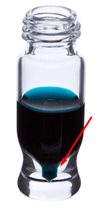
Recovery Well Geometry
Both vial designs incorporate a recovery reservoir intended to improve access to low sample volumes.
MRQ™ Configuration
Features:
- Smaller recovery well
- Stable bottom structure
- Increased total internal volume
Waters® Total Recovery Configuration
Features:
- Longer recovery well
- Deeper sample-access channel
- Extended lower profile within the vial
These differences reflect the intended sampling mechanisms rather than overall performance quality.
Internal Volume Differences
MRQ™ vials provide:
- Slightly larger internal volume
- Additional headspace capacity
Additional headspace may be beneficial for certain sample preparation procedures or applications that involve mixing, dilution, or sample handling requirements.
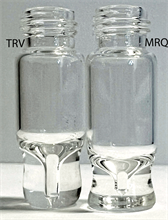
External Dimensions and Tray Compatibility
Despite the internal design differences, both vial types share standard external dimensions.
Common characteristics include:
- 12 × 32 mm vial size
- 9-425 screw-thread finish
- Standard autosampler tray compatibility
- Compatible cap and septa configurations
This dimensional consistency allows both products to fit many common autosampler racks and trays.
Stability Considerations
MRQ™ vials include a wider support area at the base of the vial.
Benefits may include:
- Improved tray stability
- Reduced tipping potential
- Consistent positioning during handling
- Enhanced support in racks and autosampler trays
These design characteristics do not alter autosampler compatibility.
Selecting the Appropriate Vial
Waters® Total Recovery Vial
Generally preferred when:
- The autosampler utilizes side-port needle technology.
- The instrument specifically requires the Total Recovery design.
MRQ™ Vial
Often preferred when:
- Bottom-inlet needle systems are used.
- High sample recovery is desired.
- Additional headspace capacity is beneficial.
- Improved tray stability is preferred.
Proper vial selection should always be based on autosampler design and injection needle configuration.
Key Takeaways
- MRQ™ and Waters® Total Recovery Vials share the same external vial dimensions.
- Both products utilize sample-recovery well designs, but the internal geometries differ.
- Waters® Total Recovery Vials are intended for side-port needle systems.
- MRQ™ vials are optimized for bottom-port and bottom-inlet needle systems.
- MRQ™ vials provide slightly greater internal volume and additional headspace.
- The wider MRQ™ base design can improve stability during handling and autosampler operation.